Search doesn’t look like it used to. Type a question into Google today and there’s a good chance you get a complete answer before you ever reach a blue link. Ask ChatGPT or Perplexity, and you get one synthesized response, no scrolling required.
This is why Answer Engine Optimization (AEO) has become such a hot topic. A recent G2 survey found that most B2B software buyers ended up choosing a completely different vendor than planned, simply based on an AI chatbot’s recommendation, and one in three bought from a brand they’d never heard of before.
If you’ve been searching for what is Answer Engine Optimization, or what is AEO in digital marketing, here’s a clear breakdown of what it is and how it differs from SEO.
What is Answer Engine Optimization (AEO)?
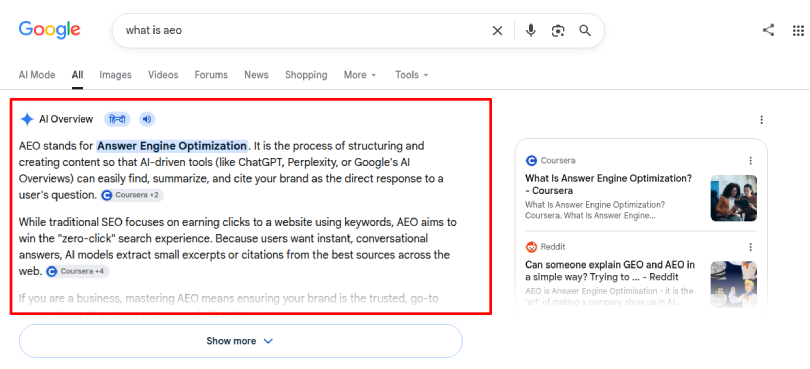
Answer Engine Optimization is the practice of shaping your content so that AI systems, think Google AI Overviews, ChatGPT, Perplexity, and Gemini, can pull it out, understand it, and use it to build the answer they show a user.
Unlike a search engine, an answer engine doesn’t hand someone ten links to sort through. It reads across multiple sources, blends the information, and delivers a single response. Your content either becomes part of that response, or the user never sees it at all.
How AEO Actually Plays Out: Citations vs Mentions
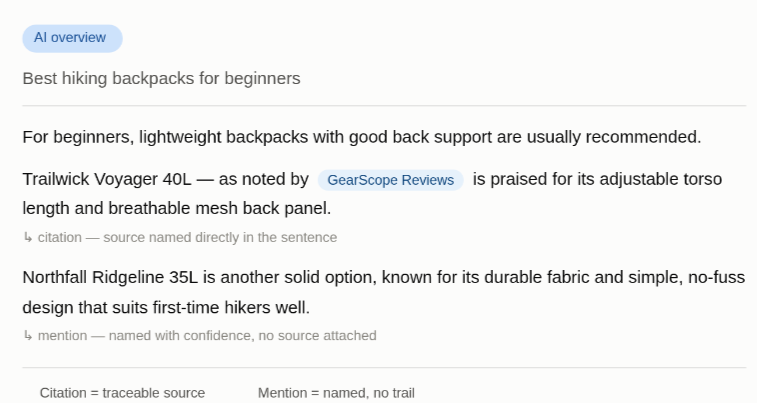
AEO works through two related outcomes. The first is being cited, where the AI engine pulls a specific fact or statistic from your page and attributes it to your site.
The second is being mentioned, where the AI engine names your brand directly as part of a recommendation, even without a direct citation.
Most businesses only pay attention to the first and completely miss the second, which is often where the real commercial value sits.
What is Search Engine Optimization (SEO)?
Search Engine Optimization is the older, more familiar discipline. It’s the work of making a website easy for search engines like Google and Bing to crawl, index, and rank, so that it appears near the top of search results for relevant queries.
SEO relies on things like keyword targeting, backlinks, page speed, mobile-friendliness, and content depth. It’s the backbone of most digital marketing strategies, and when done well, it earns a website consistent, compounding organic traffic over time.
AEO vs SEO: The core difference
Here’s the simplest way to think about AEO and SEO differences:
| Aspect | SEO | AEO |
|---|---|---|
| Goal | Rank a page in search results | Get cited or mentioned in an AI-generated answer |
| Success looks like | A click to your website | A mention, citation, or brand name inside the answer |
| Content style | Long-form, keyword-driven | Direct, self-contained, answer-first |
| Where it shows up | Google, Bing search results | AI Overviews, ChatGPT, Perplexity, Gemini, voice assistants |
| What’s measured | Rankings, organic traffic, impressions | Citation frequency, brand mentions, answer presence |
To put it simply: SEO chases the ranking. AEO chases the answer itself. This is the core of the difference between AEO and SEO.
There is also a subtler distinction in how failure looks for each. With SEO, failure is visible: your page sits on page two, and you know it.
With AEO, failure is invisible. An AI engine can read your page, use the information on it, and still leave your brand unnamed in favor of a competitor. There’s no ranking report that flags this.
Is AEO Replacing SEO?
No, and this is probably the biggest misunderstanding out there right now.
AI systems still need something to read before they can summarize it. If a website isn’t crawlable, isn’t indexed, and isn’t structured properly, an AI model has nothing reliable to pull from in the first place.
SEO builds that foundation, and AEO decides whether the content sitting on that foundation actually gets picked, quoted, or named.
SEO gets you discovered, and AEO gets you chosen. Neither one replaces the other. They solve two different problems in the same journey.
How Answer Engines Actually Choose What to Cite
AI systems don’t pick sources randomly. A few patterns show up consistently across how they decide what to lift into an answer:
- Clarity first: Content that states the answer in the opening lines gets extracted far more often than content that buries it three paragraphs in.
- Evidence and specificity: Vague claims get skipped. Numbers, examples, and named sources get pulled in.
- Consistent facts: If your brand name, offering, or details are described differently across your own site and around the web, AI systems become more cautious about citing you at all.
- Freshness: Outdated pages are less likely to be trusted, since AI models weigh recency alongside relevance.
- Structure that’s easy to parse: Clean headings, short paragraphs, and organized lists translate better than dense blocks of text.
This applies whether you’re building an AEO strategy for websites in general, an AEO strategy for ecommerce stores trying to get product answers surfaced, or an approach built around AEO for local businesses trying to show up when someone asks an AI assistant for a nearby recommendation.
How AEO and SEO Actually Work Together
SEO and AEO aren’t really separate efforts. AEO builds directly on top of what SEO already does.
Before an AI system can cite anything, it has to find it first. That happens through the same basics SEO has always relied on: site structure, load times, indexing. Without these, an AI engine has nothing to pull from, no matter how good the content is.
Once a page is discoverable, SEO helps in one more way: trust. AI systems lean on sites with strong authority signals, like backlinks and consistent mentions, because it’s a fast way to judge reliability. A well-optimized page starts ahead, even in AI answers.
AEO then decides what happens next. Once the AI system is on your page, it looks for something specific: does this answer the question clearly, right away, backed by real detail?
If yes, your content gets pulled into the response. If the answer is vague or buried three paragraphs down, it gets skipped, even if the page ranks well.
So in practice, they’re not competing efforts. SEO gets you into consideration. AEO decides whether you get picked once you’re there.
Practical Checklist
A few quick habits to start applying AEO alongside your existing SEO work:
- Answer the core question in the first two lines of a section
- Use clear headings and short, scannable paragraphs
- Keep brand and product details consistent everywhere they appear
- Add real data, examples, or named specifics instead of vague statements
- Refresh key pages regularly instead of letting them go stale
Conclusion
SEO and AEO aren’t competing strategies, they’re two stages of the same journey. SEO helps a search engine find your website. AEO decides whether an AI system trusts your content enough to speak it back to someone as the answer.
Understanding the difference between AEO and SEO isn’t about picking a side; it’s about making sure your content works for both a search results page and a synthesized AI answer, because increasingly, your audience is encountering both.
Frequently Asked Questions (FAQs)
1. Is AEO better than SEO?
Not better, different. SEO gets your site found and ranked. AEO decides whether AI tools trust your content enough to quote or name you in an answer. Skipping either one leaves a gap in how people discover your business today.
2. How do you actually get good at AEO?
Start with content that already ranks reasonably well, then rewrite the key sections so the answer appears in the first line or two, backed by a specific fact or number. Keep your brand details consistent everywhere, and revisit those pages every few months instead of publishing once and forgetting them.
3. Is AEO actually worth investing in?
For most businesses, yes. More people are asking AI tools questions instead of typing them into Google, which means a growing share of potential customers may never see a traditional search result at all. Not showing up in that answer is a real, if invisible, loss of visibility.
4. What does it take to show up often in AI answers?
Consistency and clarity, more than volume. AI systems tend to favor content that states its point early, backs it with specifics, and matches how the brand is described elsewhere on the web. Chasing keywords the way old SEO did won’t do much here.
5. Is AEO a part of AI, or something separate?
AEO is not AI itself. It is the practice of optimizing content so AI systems (search engines, chatbots, voice assistants) can find, trust, and use it. AI is the technology, and AEO is the strategy built around adapting to it.
Leave a Reply