
More people are asking ChatGPT, Perplexity, Claude, and Google’s AI Overviews questions they used to type into a search box, and the answers come with citations.
According to Statista, most U.S. adults have already used an AI-powered search tool to explore topics or look up information, while only about a third still use one mainly to find a specific website. If your site is not one of the ones getting cited, you lose the conversation entirely, not just a click.
This is the idea behind any modern AI search optimization strategy. It is no longer enough to rank. You have to be chosen as a source.
This guide covers four widely used AI platforms, ChatGPT, Perplexity, Claude, and Google AI Overviews, to explain how each decides what to cite and what you can do about it. The same principles apply broadly to other AI platforms too, since most rely on similar signals: crawler access, content structure, freshness, and trust across the web.
Why getting cited matter more than ranking now?
When an AI tool answers a question directly, most people never click through to a website at all. Getting mentioned inside that answer is quickly becoming more valuable than ranking below it, since the answer itself is often the only thing a lot of users ever see.
This matters even if you never touch AI search yourself, because your customers already are. Someone comparing options, checking a price, or researching a service before buying is increasingly doing that research inside an AI chat instead of a search results page.
If your business isn’t part of that answer, you’re not just missing a click, you’re missing the exact moment someone was deciding who to trust or buy from. A strong website that never gets mentioned in these answers is invisible during the part of the decision that actually counts.
How do these AI platforms actually choose what to cite?
Before fixing anything, it helps to know that “AI search” is not one system. Each platform has its own approach, and the four covered here are a good representation of how different the logic can be.
ChatGPT: It relies heavily on its training knowledge along with a live search layer. New content can take a couple of weeks to start showing up in its answers, so it tends to reward brands with a long history of consistent mentions across the web rather than a single new post.
Perplexity: Works almost the opposite way. It crawls and recrawls constantly, pulling in whatever is current at the moment someone asks a question. If your content is outdated or has not been touched in a long time, Perplexity has little reason to use it over a fresher competitor.
Google AI Overviews and AI Mode: Do not simply pull from whatever ranks first organically. They break pages down into smaller chunks, like a paragraph or a section that answers one specific question, and score each chunk on its own for how well it matches the exact question asked.
The answer shown to the user is built from whichever chunks score highest, even if they come from different pages. This means a page ranking seventh can still get quoted if one paragraph on it answers the question better than the page ranking first.
Claude: It is the most selective of the four. It does not search the web for every question. It first decides whether a query actually needs current or verifiable information, and only then searches, usually pulling from a smaller, more curated set of sources than ChatGPT or Perplexity. When it does cite something, it tends to pick out one specific well written section of a page rather than crediting the whole page.
The practical takeaway is that a real AI search optimization strategy has to account for the fact that a page built for one platform might be invisible to another. This applies just as much to Gemini, Copilot, or any other AI platform as it does to the four covered here. There is no single trick that works across every one of them.
Why your brand isn’t getting cited (and competitors are)?
If a competitor with a weaker product or a thinner backlink profile keeps showing up in AI answers instead of you, whether that is ChatGPT, Perplexity, Claude, Google AI Overviews, or any other AI platform, it is usually not bad luck. It is normally one of these problems.
- The AI crawlers can’t reach your site: A couple of years ago, many site owners blocked AI crawlers because they didn’t want their content used to train AI models without credit. But some of those same crawlers are also used today to fetch pages for citations. So an old block meant to stop training may still be stopping your site from getting cited now. If a crawler can’t read your page, it can’t cite it either.
- Your content takes too long to get to the point: People, and AI models too, want the answer fast. If your page makes them read three paragraphs before answering the question, a competitor who gives the answer in the first sentence will get picked instead.
- No one else talks about you online: AI tools look for other places that back up what you’re saying, like reviews, forums, or news articles. If your website is the only place your brand shows up, it looks unproven, even if your writing is good.
- Your content is old and hasn’t been updated: Pages that haven’t been touched in a long time lose out to pages that are kept current. This matters a lot to Perplexity and Google, since both care about freshness.
- Your writing sounds like an ad: AI tools are cautious about content that sounds promotional. Simple, direct, honest writing is trusted more than sales language.
- Your competitors are already mentioned in places AI trusts: If a competitor is quoted on a well-known blog, roundup articles, in official documentation, or on a site the AI already trusts, that trust rubs off on them, even if your page is actually better.
To find out which of these is really holding you back, run a simple check. Test your real customer questions on ChatGPT, Perplexity, Claude, Google AI Overviews, and any other AI tool your customers use. See who gets mentioned instead of you. This is called an AI citation audit for websites, and it takes the guesswork out of the problem.
How to get your brand cited: step by step
Step 1: Make sure the crawlers can actually reach you:
Check your robots.txt for the crawlers behind each platform. Anthropic alone runs three separate bots with three separate jobs, one for training, one for live retrieval, and one for search indexing. Blocking one does not block the others. If you cannot be fetched, nothing else on this list matters.
Step 2: Get the basics of classical SEO right:
Server-rendered HTML, clean indexing, and reasonable load speed. AI retrieval still runs on top of the same infrastructure that traditional search depends on, so skipping this step weakens everything after it.
Step 3: Write answers, not introductions:
Open each section with a direct, self-contained answer before adding context. Phrase your subheadings the way a person would actually ask the question. Name the thing you are talking about clearly instead of relying on words like “this” or “it” a few sentences later.
For ecommerce, this means product pages with clear specs and direct answers to common pre-purchase questions, not just a description. For local businesses, it means service pages that directly answer the exact question locals search, like hours or service area, instead of generic company copy.
Step 4: Add something only you could say:
Original data, a real test you ran, a screenshot from your own account, a number nobody else has published. Generic explainer content is exactly what these models already know how to summarize on their own, so it gives them no reason to send anyone to your page.
Step 5: Build visible expertise:
Use real author names and real credentials, and link to your own related articles instead of leaving each post isolated. This shows you are a consistent source on the topic, not a one-time post.
This matters most for B2B, where buyers research over several weeks and lean on named expertise. Build depth across a group of related pages rather than one long pillar page, since buyers at that stage ask narrower follow-up questions that need a precise answer.
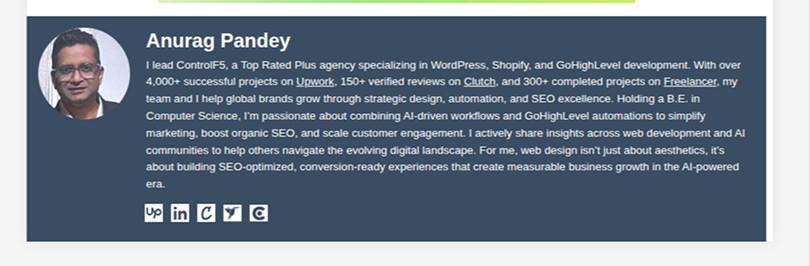
For example, ControlF5’s blog bylines each post with a named author (Anurag Pandey), a detailed credentials-backed bio, and links out to verifiable profiles on Upwork, LinkedIn, and Clutch, alongside cross-links to the author’s other related articles, giving both readers and AI crawlers a consistent, checkable identity behind the content rather than an anonymous post.
Step 6: Get talked about elsewhere:
This is one of the most important steps and one of the most skipped. Reviews, forum threads, and press coverage build the kind of outside agreement these models look for before citing anyone.
A brand mentioned consistently across the web, even without many backlinks, often does better than one with backlinks but no outside conversation.
For ecommerce AI search optimization, that means review roundups and Reddit threads and Trustpilot.
For local business AI visibility, it means Google reviews and directory listings and Clutch (especially for agencies and service businesses)
For B2B AI search optimization, it means analyst reports and platforms like G2.
Step 7: Keep it current:
Add a visible updated date, and actually update the content behind it on a schedule. Anything tied to pricing, tools, or fast moving topics needs more frequent updates than an evergreen explainer. This is especially true for ecommerce, where prices, availability, and specs change often and AI engines are cautious about outdated commercial information.
Step 8: Use schema, but keep expectations realistic:
Structured data helps with rich results and knowledge panels. Treat it as good technical practice, not a shortcut to citations on its own. Plenty of well marked up pages still get skipped in favor of ones that are simply written better.
Step 9: Publish an llms.txt file:
A small, low effort step that gives AI systems clearer instructions on how you want your content accessed, as this becomes a more common part of the landscape.
Step 10: Test, track, and repeat:
Run your real customer questions through ChatGPT, Perplexity, Claude, Google’s AI Mode, and any other AI platforms relevant to your audience, on a regular basis. Note who gets cited and why. Watch your server logs for crawler activity. Treat this as an ongoing AI citation audit for websites, not a one-time project.
Conclusion
Getting cited by AI engines is not one tactic. It comes from being technically reachable, genuinely useful, talked about consistently elsewhere, and kept current.
None of these fixes work in isolation. A page that’s crawlable but thin won’t get picked, and a well-written page nobody else talks about won’t look trustworthy enough either.
The brands that keep showing up in AI answers are usually the ones treating this as an ongoing habit, checking in regularly, fixing small gaps as they show up, rather than a one time project they finish and forget.
Build that foundation once, maintain it over time, and you stop competing for rankings and start being the answer itself.
Frequently asked questions (FAQs)
Q. I unblocked the AI crawlers weeks ago, but I’m still not getting cited. What’s wrong?
A. Access alone isn’t enough. If your content still buries the answer, is outdated, or has no outside mentions, being crawlable just confirms you’re not the best source yet. Check steps 3 to 6 next.
Q. My page ranks number one on Google, so why isn’t it the one getting cited in AI Overviews?
A. Google’s AI scores individual sections against the exact question, not the whole page. A competitor’s page can have one paragraph that answers it more directly, and that gets pulled instead.
Q. I have backlinks and decent domain authority. Why does a smaller competitor still get cited over me?
A. AI citations weigh outside conversation, like reviews and forum mentions, more heavily than link count. A smaller site with active reviews can look more trustworthy than a bigger one with links but no outside mentions.
Q. I added schema markup and my citations didn’t change. Did I do something wrong?
A. No. Schema helps with rich results, not AI citations directly. Put your effort into content structure, freshness, and outside mentions instead.
Q. How long does it take to start seeing citations after making these changes?
A. Perplexity can pick up changes within days. ChatGPT tends to lag a couple of weeks. Claude and Google AI Overviews cite selectively based on the question, so test consistently over a few weeks rather than expecting overnight results.