
Search behavior has changed fast. People aren’t just typing into Google, they’re asking ChatGPT, Perplexity, and AI Overviews direct questions and expecting direct answers. If your site isn’t built to be quoted by these systems, you’re invisible in a growing share of searches, even with good rankings.
According to Statista, trust in AI-driven recommendations is already shaping decisions. Recent consumer data shows adults under 40 act on AI-generated recommendations nearly twice as often as older adults. Being the source these systems trust and cite matters more than ever.
This AEO checklist covers the ten most impactful fixes you can make this month.
What is Answer Engine Optimization (AEO)?
Answer Engine Optimization (AEO) is the practice of shaping your website so AI systems like ChatGPT, Perplexity, and Google AI Overviews can easily find, understand, and cite your content when answering a question. Where traditional SEO focuses on ranking in a list of links, AEO focuses on being the source an AI system trusts enough to quote directly.
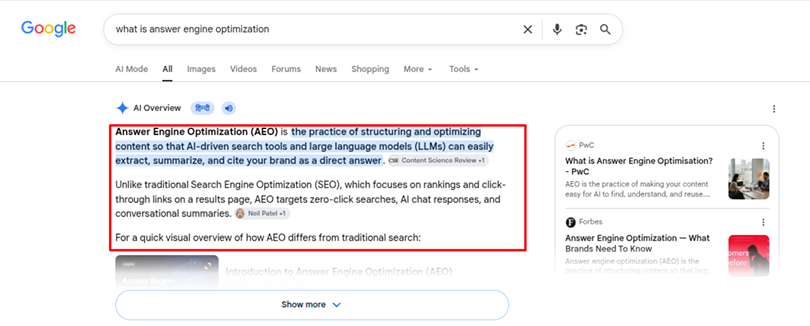
The 10-point AEO checklist:
1. Add clear author bios with real credentials
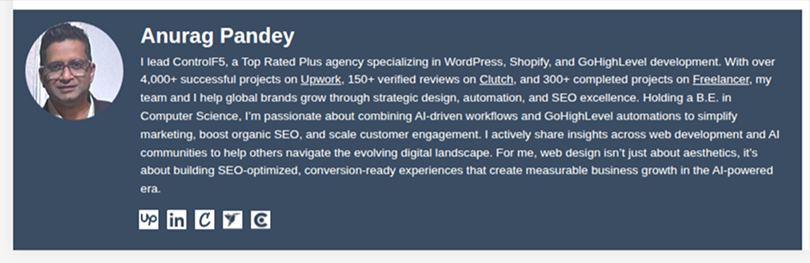
Issue: Answer engines are trained to favor content with identifiable, credible sources. If your posts are published under “Admin” or have no visible author at all, you’re handing AI systems a reason to skip you.
Solution: Add a real name, a short bio explaining relevant experience, and a link to a fuller profile or LinkedIn. This single change touches both trust and authority signals, and it’s one of the fastest wins in any AEO optimization checklist.
2. Structure content with direct-answer snippets near the top
Issue: AI answer engines look for a short, clear answer they can pull out and show to the user right away. If your article makes people read three paragraphs before getting to the point, it’s hard for AI systems to find and use that answer.
Solution: Put the main answer in the first 50–100 words of your article, then explain the details after. This is one of the most important habits in any AEO content checklist, because it decides whether your content can be picked up and quoted at all.
3. Implement Schema markup for authors, organizations, FAQs, and how-tos
Issue: Without structured data, machines are left guessing at what your content means instead of reading it directly. This is a code fix, not a writing fix.
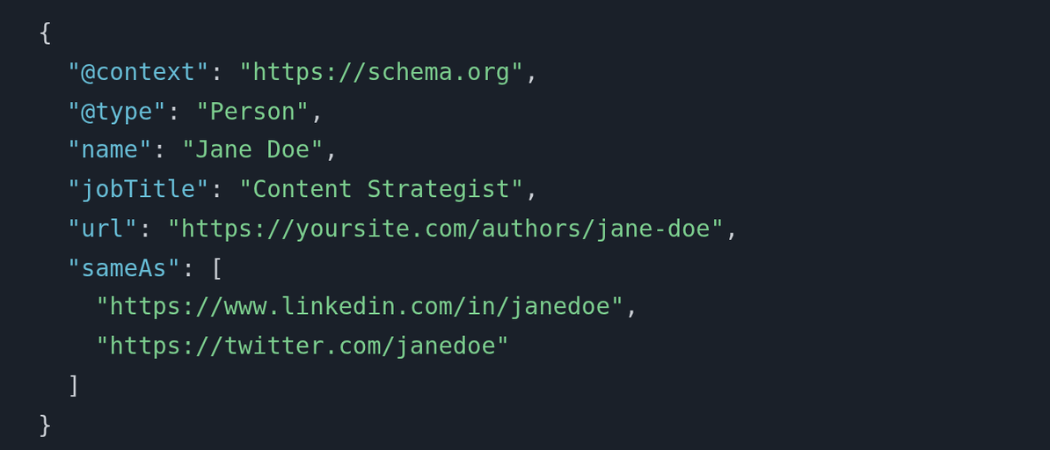
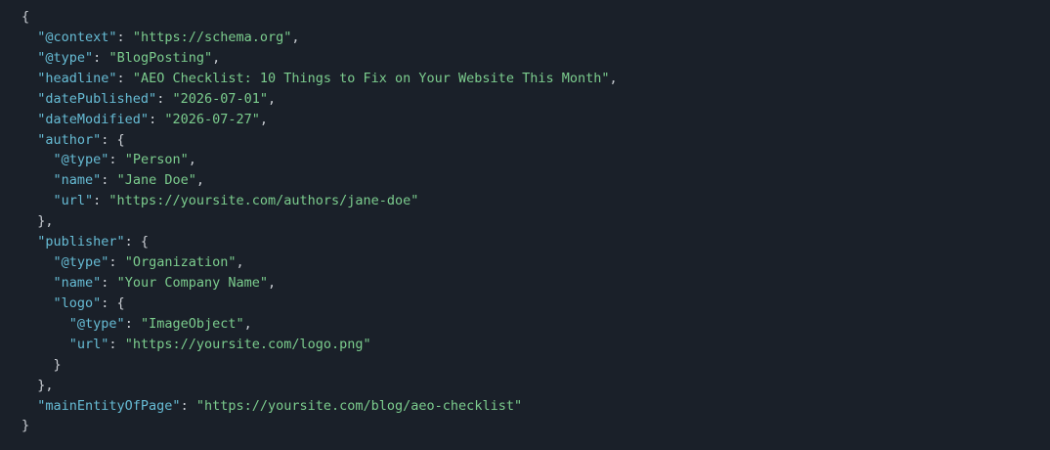
Solution: Add schema markup as JSON-LD directly into your page’s <head> or via your CMS’s structured data plugin. Author schema, Organization schema, FAQPage schema, and HowTo schema are the four most valuable types for answer engines right now.
For example:
Author (Person) schema ties content back to a real, credentialed person.
Article / BlogPosting schema establishes headline, author, and publish/update dates in one block is often the first thing an answer engine checks to confirm content is current and attributed.
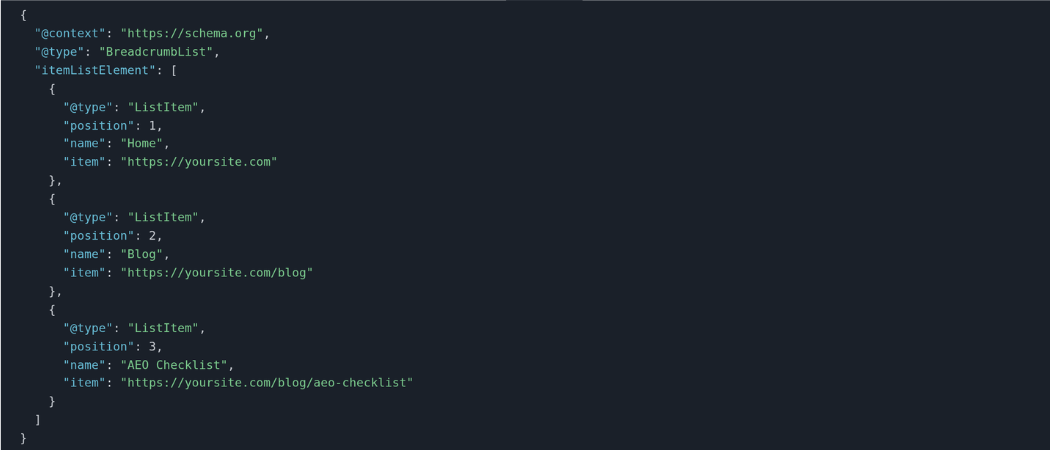
BreadcrumbList schema shows an AI system (or Google) where this page sits in your site’s structure.
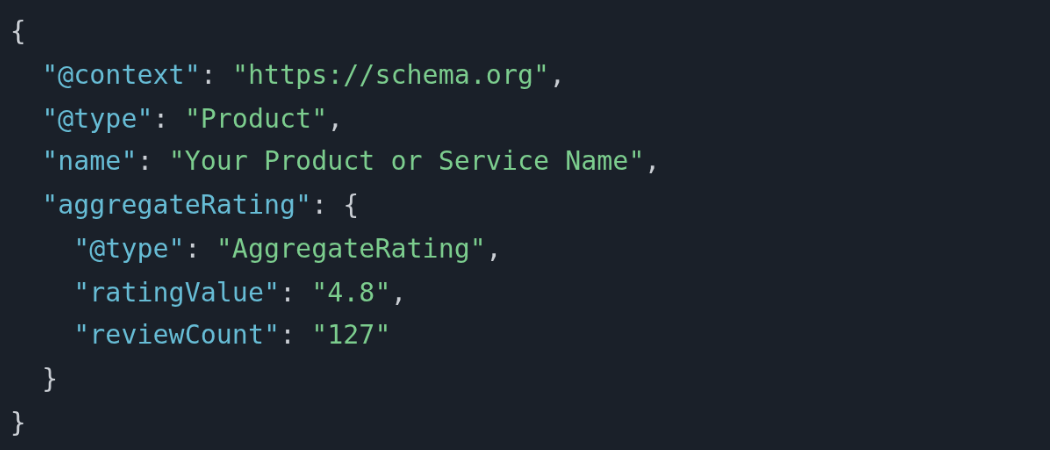
Review / AggregateRating schema surfaces star ratings and review counts directly in AI answer engine responses.
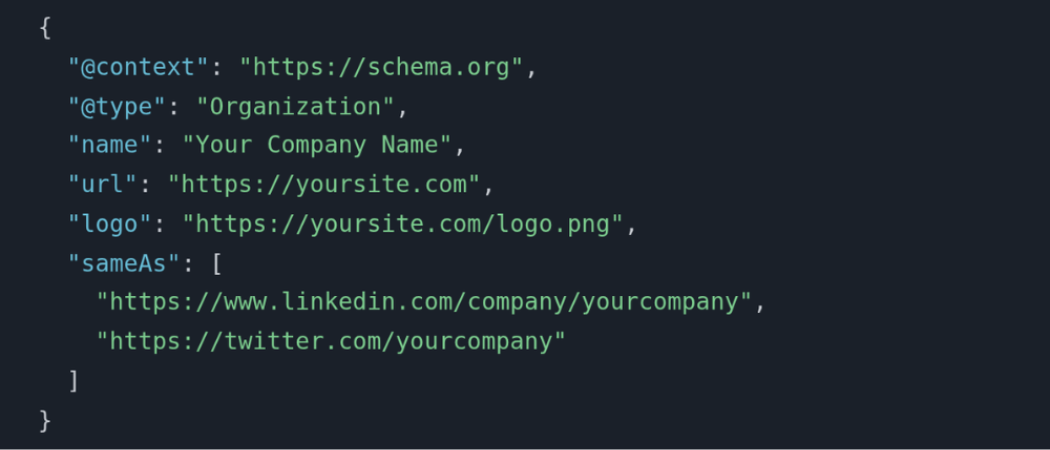
Organization schema helps answer engines confirm who’s actually publishing the content, and is usually placed sitewide (e.g., in a shared header/footer template) rather than per-article.
If you’re on WordPress, plugins like Yoast or Rank Math can generate most of this for you. You just need to fill in the fields and validate the output. If you’re on a custom stack, this goes into your template layer, not your CMS content editor. Either way, validate every implementation in Google’s Rich Results Test and Schema.org’s validator before publishing.
If you haven’t touched structured data in the last year, this is the centerpiece of your AEO schema checklist. Even partial implementation, starting with FAQ and Author schema, creates a measurable lift in how often AI systems correctly attribute and surface your content.
4. Cite original data, studies, or first-hand experience
Issue: Generic, rehashed advice is easy for AI systems to find anywhere, which means it’s easy for them to ignore too. If your content says the same thing as a hundred other sites, there’s no reason to cite you specifically.
Solution: Publish original experience: your own data, your own test results, your own case studies. If you run a product, publish usage numbers. If you offer a service, publish outcomes. If you’ve tested something, show the process. This is where genuine experience becomes a competitive advantage rather than a checkbox.
5. Fix outdated or unverified claims
Issue: Nothing damages trust signals faster than stale information. A statistic from 2019 presented as current, a pricing figure that changed last quarter, an “as of today” claim buried in an old post: all of these erode the confidence an answer engine places in your domain.
Solution: Set a recurring quarterly audit to flag and update anything time-sensitive. This is a small operational habit, but it belongs at the top of any recurring AEO audit checklist because trust, once damaged at scale, is slow to rebuild.
6. Strengthen internal linking to topic-authority pages
Issue: Answer engines assess authority partly by how a site organizes and reinforces its own expertise. A collection of disconnected articles signals shallow coverage, even if each individual piece is well written.
Solution: Identify your two or three core topic areas, then make sure every related article links back to a central, comprehensive resource page. This structural work is a core part of any technical or AEO technical checklist, since it affects crawlability and topical mapping as much as it affects user experience.
7. Add transparent sourcing and external citations
Issue: Sites that only ever link to themselves, or to other blogs repeating the same claims, look like a closed loop to an answer engine, not a verifiable source. If nothing on your site points outward to independent, credible sources, there’s little for an AI system to use to confirm your claims are accurate.
Solution: Link out to primary sources, government data, peer-reviewed research, or original reporting whenever you make a factual claim. Just as important: pursue mentions and citations on third-party publications, forums, and review sites, since that’s where most AI citation weight actually comes from, not from publishing more content on your own domain.
8. Optimize for conversational, question-based queries
Issue: People don’t ask AI assistants the way they typed into Google a decade ago. Queries are longer, more specific, and phrased as full questions: “What’s the best AEO checklist for a B2B SaaS company with a small content team?” rather than “AEO checklist.” Content written for short, keyword-style queries doesn’t match how these questions are actually phrased.
Solution: Restructure your headers and subheadings as natural questions, and answer each one directly underneath. This is especially important for anyone building an AEO checklist for b2b saas business, where buyer questions tend to be longer and more specific than typical consumer searches. Think procurement, integration, and security concerns rather than simple product questions.
9. Open your site to AI crawlers and fix technical trust signals
Part A: Crawler access (robots.txt and llms.txt)
Issue: Even perfect content is worthless to an answer engine if its crawler is blocked at the door. Many sites unknowingly block AI user-agents like GPTBot, PerplexityBot, ClaudeBot, or Google-Extended in their robots.txt file, often left over from a security plugin or a hosting provider’s default configuration.
Solution: Check robots.txt (usually at yoursite.com/robots.txt) and update it to allow AI crawlers. A permissive rule set looks like this:
User-agent: GPTBot
Allow: /

User-agent: PerplexityBot
Allow: /

User-agent: ClaudeBot
Allow: /

User-agent: Google-Extended
Allow: /
It’s also worth adding an llms.txt file at your site root. This is an emerging convention that gives AI systems a curated summary of your most important pages, similar to how a sitemap works for search engines. This is optional today but low-effort and forward-looking.
While you’re in your site settings, confirm your XML sitemap is current and submitted in Google Search Console, and check that canonical tags aren’t accidentally pointing key pages to the wrong URL. This is a common issue after a site migration or CMS switch that quietly tells crawlers to ignore your best content.
Part B: Baseline trust signals
Issue: Before any content-level optimization matters, the basics need to be solid. Missing HTTPS, a broken contact page, or an absent privacy policy signal low trust to both AI crawlers and human visitors, regardless of how good your writing is.
Solution: Enforce HTTPS site-wide (check for mixed-content warnings in your browser console), add an accessible privacy policy, and keep a working contact page with clear business information in your footer or About page.
For AEO checklist for ecommerce websites, this also means visible return policies, shipping information, and verifiable business details in your checkout flow settings. For an AEO checklist for local businesses, it means consistent name-address-phone (NAP) data across your site and Google Business Profile, plus LocalBusiness schema with accurate geo-coordinates. This is a settings and code fix, not just a content one.
10. Monitor brand mentions across AI answer engines
Issue: Traditional rank tracking tools won’t tell you if ChatGPT or Perplexity is citing your site, so most businesses have no idea whether their AEO work is actually paying off.
Solution: Start manually testing relevant queries in each major answer engine monthly, and track whether your brand, articles, or data appear in the responses.
This monitoring habit turns your checklist from a one-time project into an ongoing AEO readiness checklist, because answer engine behavior shifts often, and what worked last quarter may already be outdated.
Beyond monitoring, actively pursue placement in “roundup” or “best of” articles, third-party posts that list and compare products or services in your category.
Answer engines lean heavily on these comparison-style articles when generating recommendations, since they already do the work of evaluating multiple options in one place.
Getting listed in a handful of relevant roundups can do more for your AI citation visibility than months of on-site content work alone.
Turning this into an AEO implementation roadmap
A checklist is only useful if it becomes a habit. Rather than trying to fix all ten items in one sprint, consider spacing them into a simple AEO implementation roadmap:
- Week 1: Author bios, technical trust signals, outdated content audit
- Week 2: Schema markup implementation across key pages
- Week 3: Content restructuring for direct answers and conversational queries
- Week 4: Internal linking cleanup, external sourcing review, and first round of AI answer engine monitoring
Repeat this cycle monthly. Answer engines are evolving quickly, and the sites that treat AEO as an ongoing discipline, not a one-time project, are the ones that will keep showing up as the trusted, cited answer, regardless of which platform someone is asking.
Conclusion
The core idea behind every item on this list is the same: answer engines reward clarity, verifiable expertise, and trust signals that are easy for machines to parse and easy for humans to believe. None of these fixes need a full rebuild, most can start this week.
Treat this checklist as a monthly habit, not a one-time cleanup. Fix these ten things now, and you’ll have a website built for how people actually search today.
Frequently asked questions (FAQs)
Q. I don’t have a developer. Can I still add schema markup?
A. Yes, on most platforms. WordPress, Shopify, and Squarespace all have plugin or app-based options that need no code. Only fully custom sites usually need a developer. If you’d rather not handle it yourself, agencies like ControlF5 can set up schema markup and broader AEO implementation for you.
Q. Could I accidentally block AI crawlers while blocking bad bots?
A. Yes, this is common. Security plugins often lump GPTBot, ClaudeBot, and PerplexityBot in with malicious traffic. Always check robots.txt by name for each AI bot.
Q. How do I know if an AI system is citing my site?
A. Manual testing is still the most reliable method. Run your target queries in ChatGPT, Perplexity, and Google AI Overviews monthly and check for your brand or wording.
Q. Is the checklist different for ecommerce vs. SaaS vs. local business?
A. Yes. Ecommerce should prioritize transactional trust and product schema. B2B SaaS should prioritize conversational, question-based content. Local businesses should prioritize NAP consistency and LocalBusiness schema.
Q. Could this hurt my traditional SEO rankings?
A. No. Every fix here, clear authorship, structured data, updated facts, strong internal linking, is also a recognized SEO best practice. AEO work reinforces existing rankings rather than competing with them.